Corallo Sonoro · 4
Invertebrats

Text original en anglès.
Stomatopod (Hemisquilla californiensis)
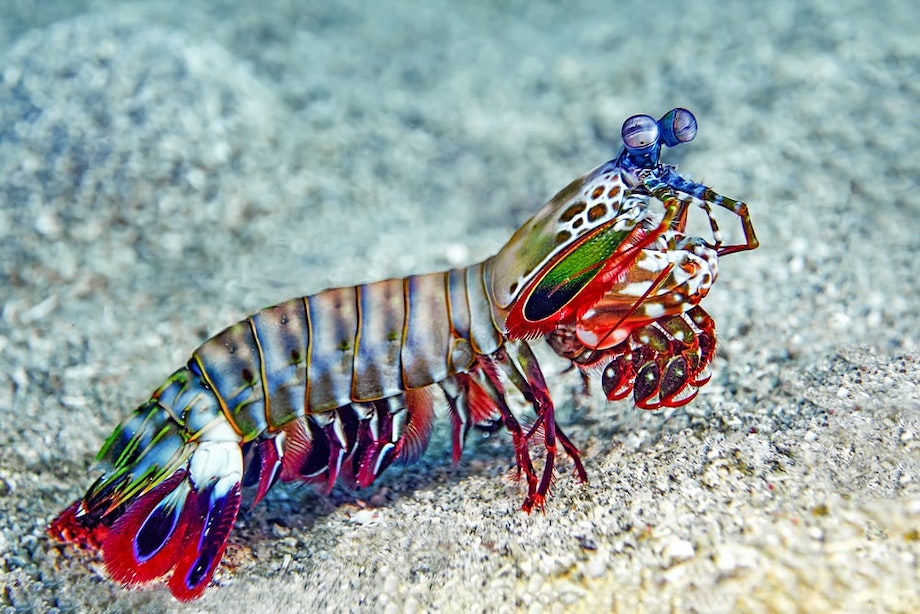
Stomatopods (also known as “Manhis Shrimps”), are benthic marine crustaceans of which about 350 species are known, ranging in size from 2 to 30 cm. Most are found in shallow, tropical or subtropical waters and live in crevices or cracks, among debris, or in burrows they build in sand or mud.
Mantis Shrimps are aggressive predators that feed mainly on fish, crabs, snails and shrimp. Their eyes are pedunculated and mobile, providing excellent vision.
Stomatopods are divided into two groups by the different hunting methods they use: the “spearers” and the “crushers.” Spearers use sharp appendages to spear and/or slice their prey. Their raptor appendages have spines that are used to catch and stab their prey, usually unsuspecting fish. Schicciators, on the other hand, use a large club-like appendage to crush prey with hard shells or exoskeletons, such as snails and crabs.
The stomatopods’ predatory blows are extremely rapid. In the peacock mantis shrimp, Odontodactylus scyllarus, which uses a hammer-like appendage to smash the shells of its prey, blows are known to reach a maximum speed of 23 m/s. As a result of this fast, crushing motion, bubbles form and then immediately collapse (cavitation), a process that produces heat, light, and sound.
The California mantis shrimp, Hemisquilla californiensis, produces sounds by vibrating its carapace, like the American lobster. The low-frequency noises of the mantis shrimp are about 167 Hz and last about 0.2 s. Although each animal produces its own distinct sound, scientists have recorded multiple individuals in an area producing noises at the same time. Acoustic activity is also high during dawn and dusk, a time when the animals are feeding or guarding their burrows.
Lobster (Palinurus Charlestoni)
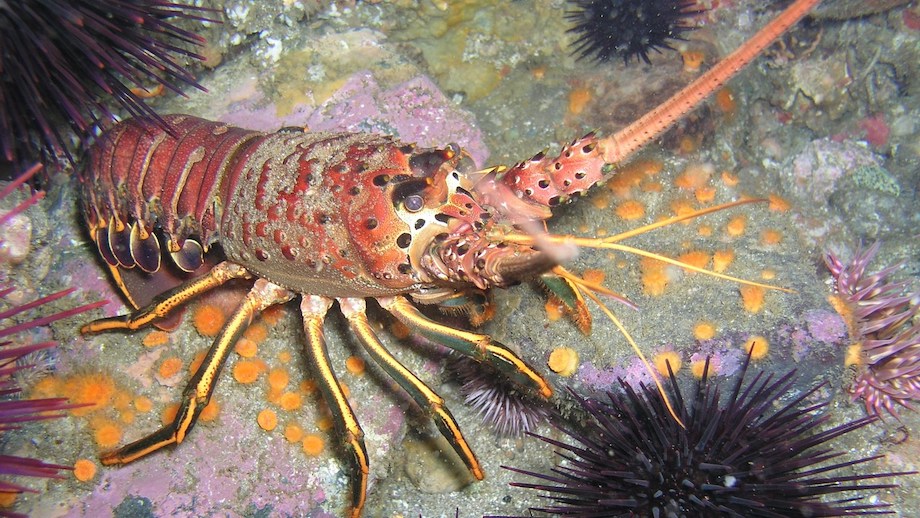
Lobsters are marine invertebrates found throughout the world. These lobsters (which unlike lobsters do NOT have claws) belong to the family Palinuridae and are characterized by their two long antennae.
Lobsters sometimes migrate in very large groups in long rows of animals on the sea floor. These rows can be more than 50 individuals long. Lobsters navigate using the smell and taste of natural substances in the water that change in different parts of the ocean. It was recently discovered that lobsters can also navigate by sensing the earth’s magnetic field.
Other arthropods are able to generate sounds by rubbing together two hard parts of their exoskeleton, while lobsters employ a slightly different technique: these animals rub a piece of soft tissue called a plectrum against a smooth, stiff file that is located near their eye. The plectrum rubs against the file and produces a rasping sound. This technique resembles a bow moving over the strings of a violin. The sound produced is probably used to protect themselves from predators. By not relying on a hard exoskeleton to produce sounds, lobsters are also able to protect themselves when they are most vulnerable, after molting.
Sea urchin (Evechinus chloroticus)
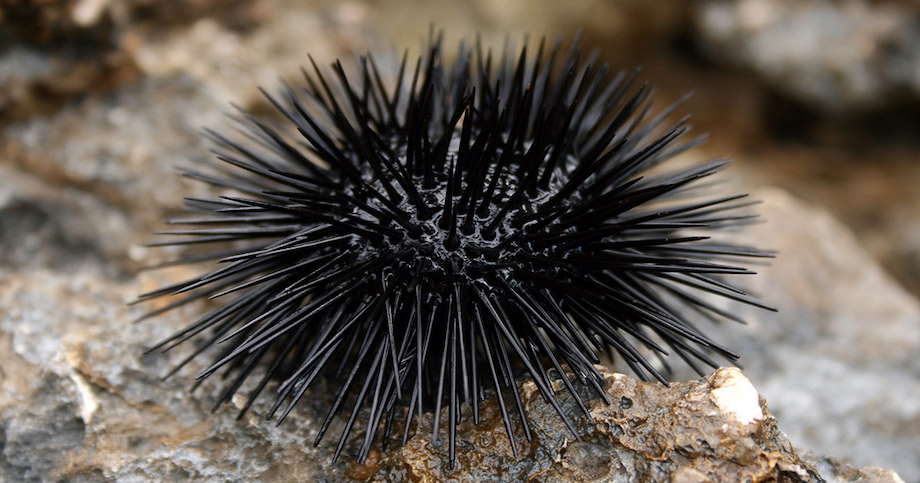
There are about 700 species of sea urchins. These animals are a type of echinoderm commonly found in seagrass beds, rocky shores and coral reefs. Sea urchins typically range from 6 to 12 cm in diameter, although the largest species of urchin (the red urchin, Strongylocentrotus franciscanus) can reach a diameter of more than 18 cm. Hedgehogs have a roughly spherical body covered by a rigid exoskeleton that consists of numerous calcium carbonate plates. The body is covered with spines, which are long and in some species sharp and are used to protect the animals from predators. In addition, the body of the hedgehog is covered with hundreds of small adhesive tubular feet, which are used for locomotion and transporting food.
The lower part of the sea urchin’s body is called the “oral surface” because it contains the mouth. The mouth of most urchins is composed of a complex five-part triangular calcium carbonate structure (called Aristotle’s lantern) with large teeth and a fleshy tongue-like part. Although sea urchins are mainly herbivores they can also feed on sea cucumbers, mussels, worms, sponges and soft sea stars.
Grazing sea urchins produce underwater sounds that contribute to the underwater soundscape. The calcified shell of the sea urchin acts as a resonator. This resonance causes the production of sounds that vary in frequency from 800 Hz-28kHz.
Ambient sound levels in coastal waters tend to increase immediately before sunrise and after sunset during the “sunrise chorus” and “evening chorus“. The evening chorus of urchins is distinctive and can be an important acoustic source of habitat information for other marine organisms that hear this sound.