Corallo Sonoro · 5
Mamíferos pinnípedos

Texto original en inglés.
Leopard seal (Hydrurga leptonyx)
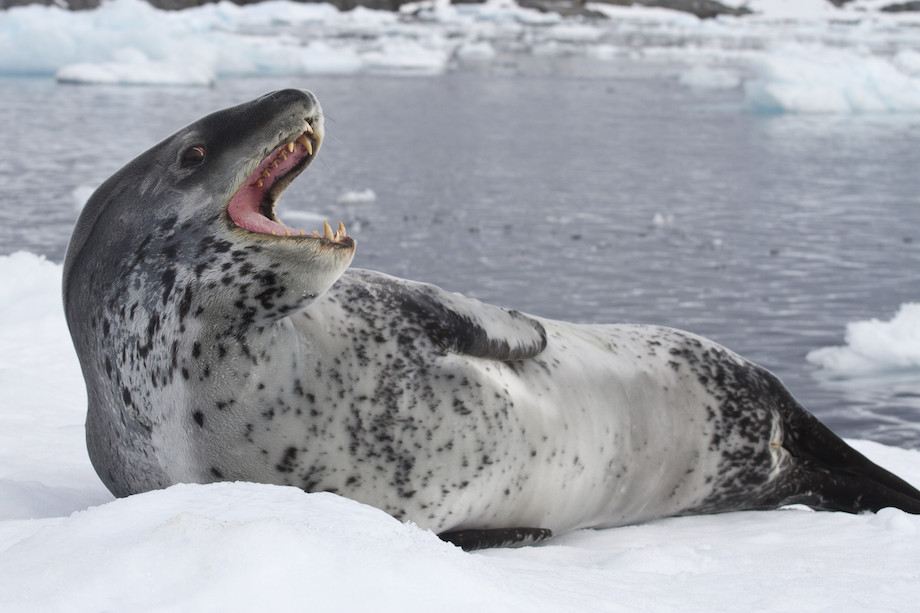
Leopard seals are quite large and vigorous, reaching up to 4 m in length and 500 kg in weight. Usually females are larger than males. They have dark gray backs and heads, and much lighter bellies. Spots are present in the chest, resembling a leopard, hence the name of this species.
They have a slender body and are very skilful and fast swimmers. The head and jaws are strong and well-developed as is the neck, which gives the leopard seal a reptile-like appearance. Their teeth are also distinctive: in fact, like many other carnivores, they possess rather sharp front teeth, while the molars close in such a way as to allow krill to filter out of the water.
Leopard seals are fearsome predators: in addition to krill, their diet includes fish, seals and penguins, which they hunt as true predators.
During the austral summer (November to January), leopard seals breed on the outer bangs of the Antarctic pack. Both sexes vocalize a lot during this period for short-distance “local calls” and long-distance “broadcast calls.” Because leopard seals are infrequent throughout the pack, finding a mate during the short breeding season can be difficult. Therefore, it is hypothesized that acoustic communication plays an important role in locating and identifying a mate.
Female leopard seals produce broadcast calls during the breeding season, but only for a short period. In contrast, male leopard seals become highly vocal before and during the breeding season, and produce highly stereotyped underwater vocalizations for long periods each day. Their calls include low-frequency tonal calls, narrow- and broadband high-frequency pulses, and frequency-modulated calls ranging from 50 Hz to 8 kHz. The vocal repertoire of male leopard seals has individual and age-related differences-the seals share common sounds but combine them into distinct sequences individually. There is also geographic variation in male vocalization types.
Leopard seals also produce vocalizations in association with agonistic interactions. Leopard seals in captivity have been found to produce diving growls and explosion sounds in association with aggressive behaviors such as lunging (with open mouth, teeth exposed) and parallel swimming.
Weddell Seal (Leptonychotes weddellii)
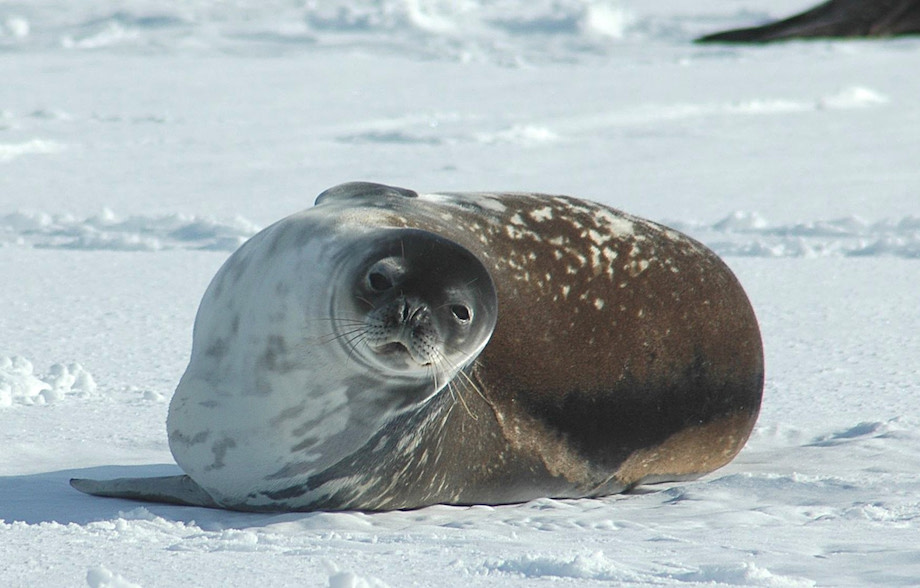
Weddell seals are found only in the Antarctic region. These seals can dive for up to 73 minutes and reach a depth of 600m, although they mostly dive at 300-400m.
Adults are about 3m long and can weigh up to 400-600 kg. They have very large bodies and tiny heads.
Weddell seals eat fish, crustaceans and cephalopods, although they have also been observed eating penguins of the “chinstrap” species. They are very creative in pulling fish out of ice crevasses. If a fish hides in a crevasse, the seal blows air bubbles into the water to flush out the fish and chase it into open water.
Weddell seals make many different types of underwater vocalizations that are used in social interactions to define their territory and/or in an aggressive function. Weddell seals produce trills, whistles, low-frequency hums and chirps. The frequency range of vocalizations is 80 Hz – 24 kHz (human listening range is 20-20KHz).
Bearded seal (Erignathus barbatus)
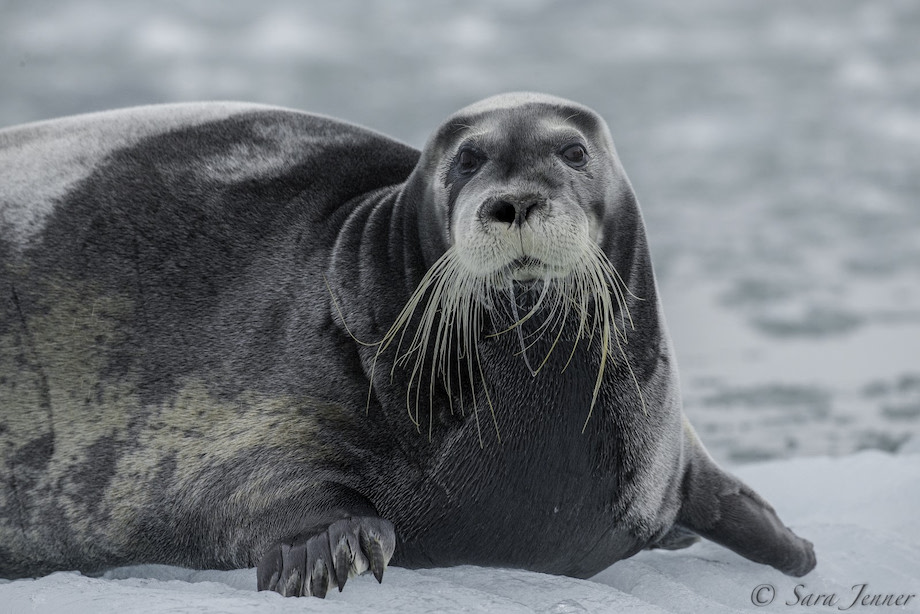
Bearded seals are cold-water seals that live in the circumpolar regions of the Northern Hemisphere. These seals are named for their long, numerous whiskers. Bearded seals can also be identified by their square-shaped front flippers (in fact, the Norwegian name for the bearded seal is precisely “square flipper”).
Adults are 2-2.5 m long and weigh on average 200-250 kg. Females are often larger than males. These seals tend to be solitary in the wild, but can also be seen in small groups on the ice. Their diet consists mainly of crabs, shrimp and clams, but they may also take fish, particularly Arctic cod. Polar bears, walruses and killer whales are the natural predators of bearded seals.
They produce sounds ranging from 0.02 – 11 kHz in frequency (the human audible spectrum is 20-22KHz). These complex vocalizations consist of long, spiraling trills, shorter calls, flat, tonal grunts, and short, low-frequency moans that show clear geographic variation. As they sing, bearded seals slowly dip into a spiral, releasing bubbles and finally emerging at the center of the circle they have made. Bearded seals breed in water, and the long songs of males are thought to advertise their reproductive status to nearby females. It is likely that trill duration indicates the “quality” of the male, with longer trills implying greater reproductive performance and success. The vocalizations are heard only during the breeding season, which lasts about 90 days, from about late March to mid-July.